
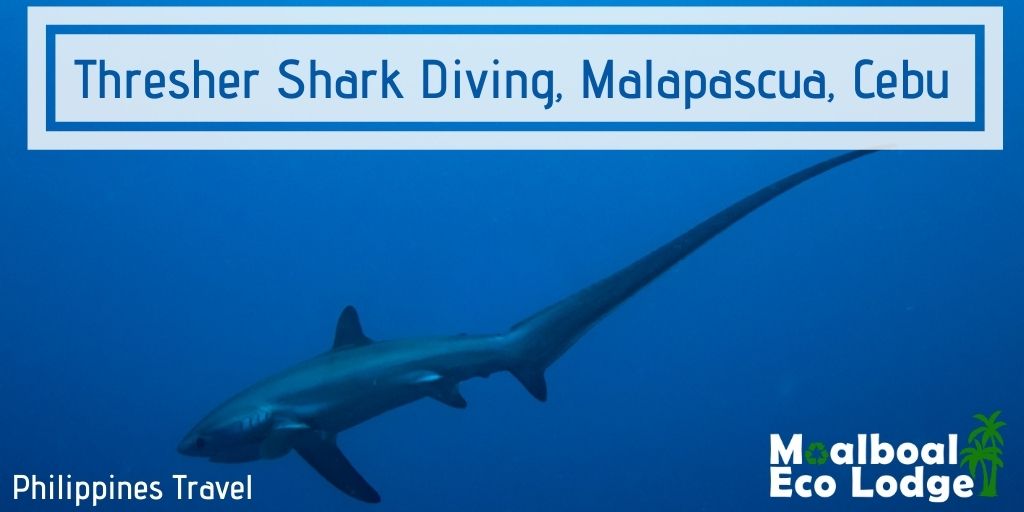
Who wants to dive with sharks?
Diving with Thresher Sharks in Malapascua, Cebu, Philippines should definitely be on your scuba diving bucket list. Thresher Sharks are not dangerous to humans, and to encounter these beautiful, graceful creatures of the deep is a truly magical experience. Many visitors to Cebu combine Moalboal and Malapascua for two of nature’s greatest phenomenon; the sardine run in Moalboal and Thresher Sharks at Monad Shoal in Malapascua. When we discovered we could dive with Threshers in an ethical way any day of the year, we immediately added this destination to our Cebu itinerary Malapascua is the only place in the world where you can see Thresher Sharks all year round. We only participate in natural animal encounters, and there is no feeding, no cages or baiting involved in any of the Thresher Shark dives. So what is it like to see a 10 feet torpedo shaped shark suddenly appear out of the blue? Moalboal Eco Lodge share their experience of scuba diving with Thresher Sharks in Malapascua, Cebu.
0 Comments
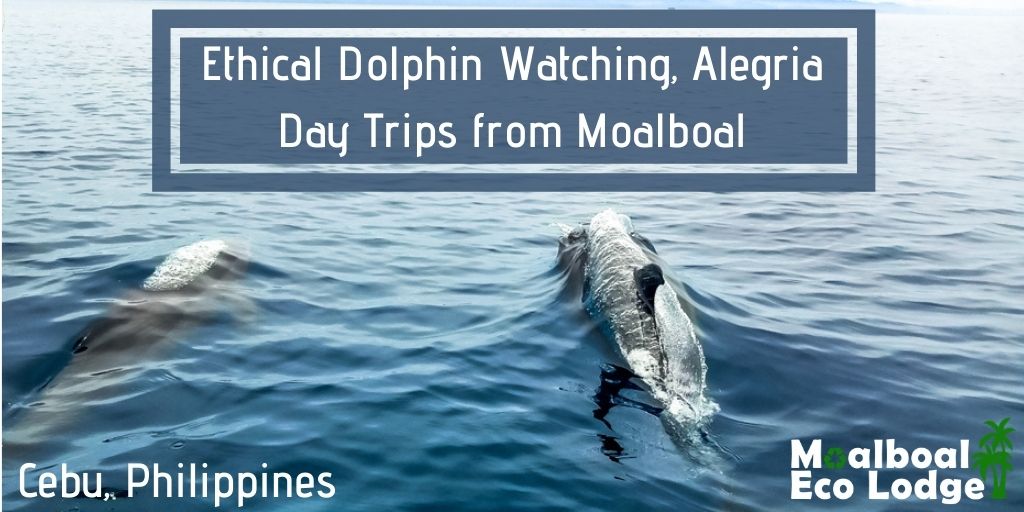
In the Philippines, there are many islands where you can go dolphin watching. We have been twice, once in Alegria, and the second time was just off Panagsama Beach in Moalboal for sunrise.
Dolphin watching in Cebu is the perfect day trip from Moalboal, and as this has been on my bucket list for years, I was keen to give it a try. But is it ethical? We only support ethical animal encounters, and when our research discovered there was no feeding, no chasing, no touching, no human involvement to attract the dolphins, we knew this was the sustainable dolphin watching experience we wanted. The only tricks the dolphins performed were because they were having fun in the wild – the best way of seeing them. Our dolphin watching experience in Cebu was amazing and unforgettable. Viewing these playful and intelligent animals in their natural habitat was very special, and a memory that will stay with us forever. In a series of articles showing day trips from Moalboal, Moalboal Eco Lodge share ethical dolphin watching in Alegria, Cebu. Update: Dolphin Watching is no longer an option in Alegria, only in Moalboal. It is weather dependent, and only available certain times of year. 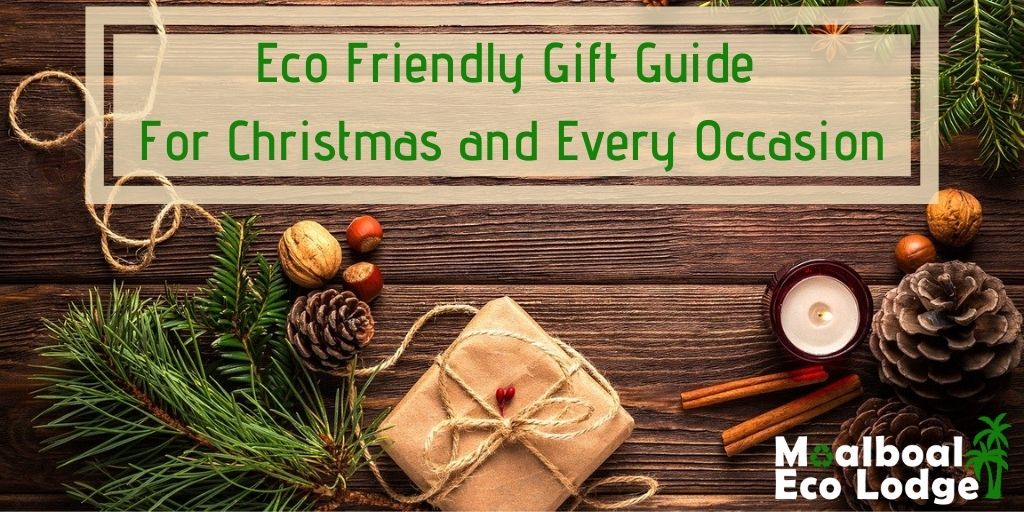
As Christmas approaches, 2020 will undoubtedly be the strangest festive season any of us have experienced. Yes things will be different, and if you are someone who loves to celebrate Christmas, you can still do so in style, but it may require a different approach.
Choosing a more sustainable approach to Christmas is the way to a better future. If you watched Netflix’s David Attenborough documentary “A Life on Our Planet”, you will have heard his plea regarding climate change, and how we need to do something now. Every year the festive season is a time of excess; too much eating and drinking, buying so many presents people get into debt, stressing about cooking far too much food it ends up wasted in landfills. Although it is the season to be jolly, the spirt of Christmas has become lost. It’s not about how much money you spend or how many presents you buy. If 2020 has shown us anything, it’s to value time spent with friends and family more. Christmas is the season for being charitable, and after a difficult year, presents are not always the best way of showing your love. Remember that spending lots of money on a gift doesn’t necessarily make it special. Moalboal Eco Lodge share an eco friendly gift guide for all occasions; Christmas, Mother’s Day, Father’s Day, Birthday, or any occasion where you need to give a present. 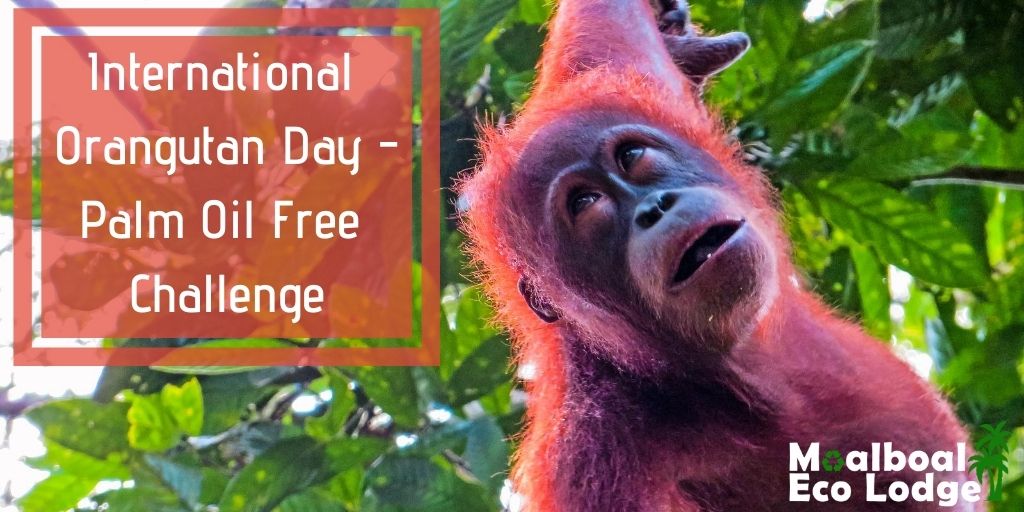
Orangutans are being killed. The Sumatran Tiger, Sumatran Rhino and Sumatran Elephant are dying and classed as “critically endangered”.
Deforestation in Indonesia is escalating climate change, and increasing the number of landslides and flash floods. Why? Because of the palm oil industry – a “harmless natural” oil used in over half the products on our supermarket shelves, including foods, toiletries and cosmetics. Palm oil is also used as biodiesel in USA and Europe. The unsustainable collection of palm oil is the new secret killer. The key word here is unsustainable. How? Borneo and Indonesia produce 85% of the world’s palm oil, which involves cutting virgin rainforests, then burning the land to make way for oil palm plantation. Orangutans and the other endangered animals mentioned only live in Borneo and Sumatra (Indonesia) so their habitat is being destroyed. Orangutans suffer the most, with over half their population being killed in the past 15 years. We will explain why the unsustainable collection of palm oil is killing the Orangutans, and how deforestation for the palm oil industry is contributing to climate change. Find out the outcome of Moalboal Eco Lodge's Palm Oil Free Challenge in support of International Orangutan Day. 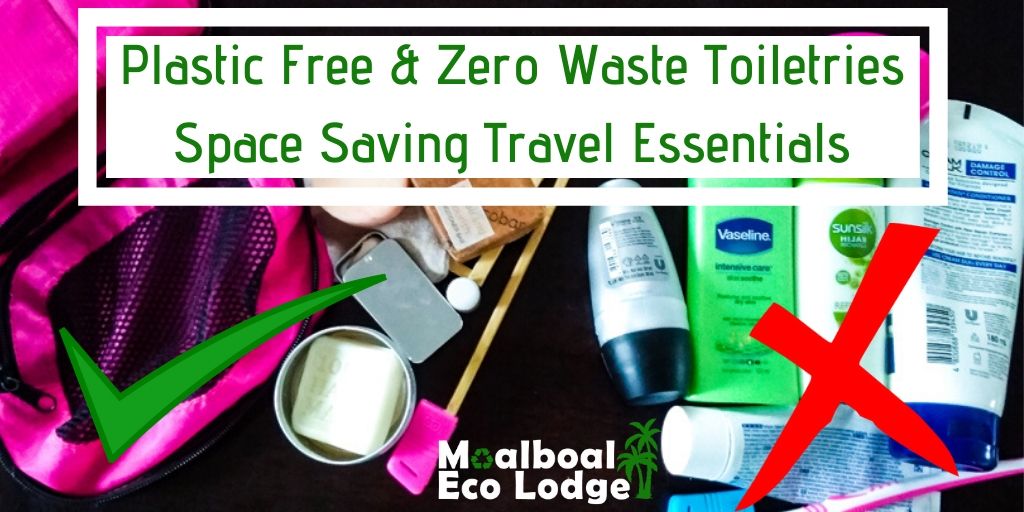
FACT: Switching your toiletries to plastic free or zero waste will give you more luggage space, AND reduce your suitcase or backpack weight. Great news if you are taking a trip and want to use a small bag, especially if you are travelling by plane.
In future travel, flying under “the new normal” means some airlines (such as British Airways) are only allowing hand luggage which can fit underneath your seat. If you usually take a few toiletries in your carry-on bag in case of lost luggage, moving to plastic free options will be perfect for you. Overhead lockers may be out of use in post-Coronavirus lockdown, minimising touchable surfaces within the plane and reducing unnecessary movement. However, this does mean only essentials can be taken on board such as your passport, mobile phone, hand sanitiser, face mask, pen, small snack etc. Airlines may also be reducing the weight limit for checked in baggage. The heavier the aircraft, the more it cost to fly and airlines are already struggling after months of being grounded. To keep ticket prices as affordable as possible but still recouping lost revenue, airlines have to reduce costs any way they can. By switching your toiletries to plastic free or zero waste, you will save valuable weight, save space, the 100ml liquid limit doesn’t apply, and you don’t have to worry about liquids spilling over your clothes. Moalboal Eco Lodge share how you can make a few easy plastic free and zero waste changes to your toiletries. 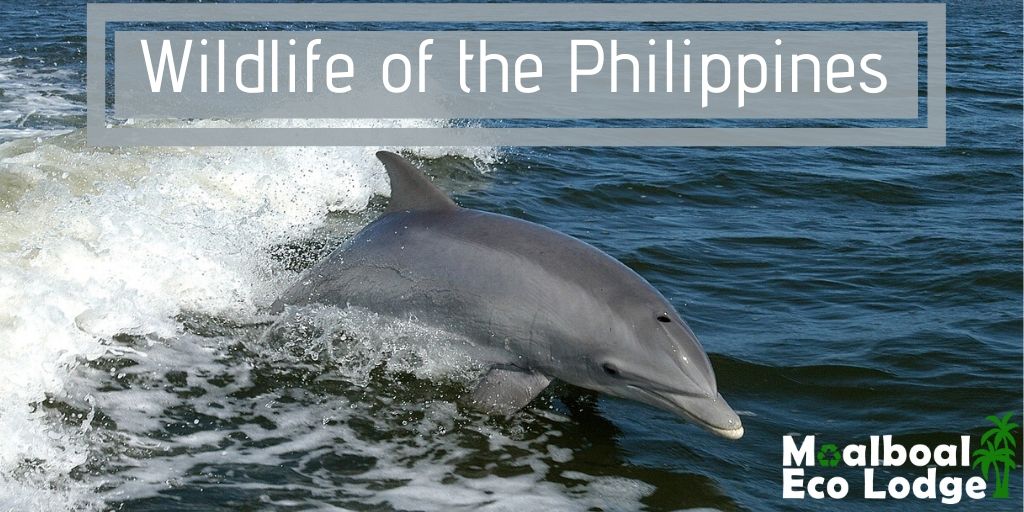
The Philippines is located in the coral triangle, the most bio-diverse region in the world. When asked “what wildlife can I see in the Philippines”, with over 52,177 species of wildlife, the answer is “a lot”.
For animal lovers, there is plenty to be seen above and below the water. The most famous wildlife found in the Philippines is the whale shark, but there is also the Philippine Tarsier, the smallest primate in the world, and the Philippine Eagle, the largest eagle in the world, and endemic to the Philippines. Do you know where to find the world’s largest flower, the Rafflesia, in the Philippines? At Moalboal Eco Lodge, we are huge animal lovers, and are surrounded by nature day and night. Regardless of whether wildlife is big or small, bird, insect, or fish, we are passionate them all. In this article, we share 10 different wildlife which we feel are the most impressive for various reasons. Some of the wildlife featured are only found here in the Philippines, some are iconic, some are weird, and some are just beautiful. So for visiting nature lovers this is wildlife of the Philippines. 
As travel resumes following the COVID-19 pandemic quarantine and lockdowns, extra precautions will need to be taken. Living a “new normal” life will include more thought and preparation if we are to remain safe and healthy, but it shouldn’t be at the expense of our planet.
Single use face masks, small hand sanitiser bottles, latex gloves, polystyrene take-out containers, plastic bags – it’s already polluting our planet and having catastrophic effects on the war against single use plastic. Disposable masks and gloves have been found on beaches which are washed into the ocean during high tide, and have been discovered littering nature trails, park-lands and green areas. Sustainable practices often take a back seat in times of crisis, but for people who wish to travel responsibly, we have to continue fighting. Until a vaccine is found we will all be living with the threat of COVID-19, but staying safe during Coronavirus doesn't mean more plastic. The way forward is not to disregard all we have learnt about zero waste and using less single use plastics, but to continue with the good practices already in place. YES YOU CAN BE PLASTIC FREE AND ZERO WASTE DURING THE CORONAVIRUS PANDEMIC. Moalboal Eco Lodge want to help you travel eco-friendly after COVID-19 quarantines, so here are our 12 plastic free and zero waste travel tips during Coronavirus. 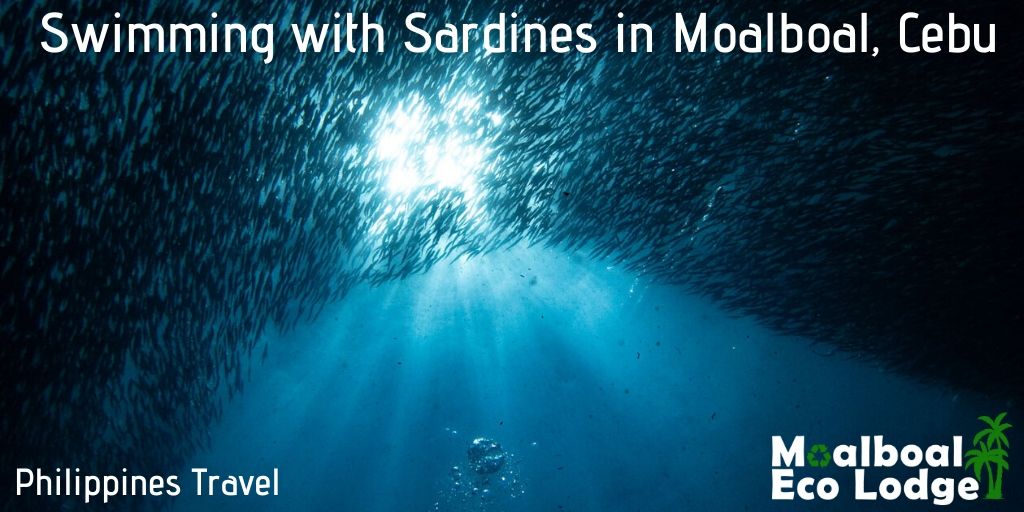
Have you ever dreamt of snorkelling with turtles, and swimming with sardines? If this is on your must-see bucket list of things to do when visiting the Philippines, Moalboal’s sardine run at Panagsama Beach, Cebu needs to be added to your travel itinerary.
Moalboal’s main tourist attraction is the sardine ball where literally millions of silver shimmering sardines can be seen just off the beach. Every day of the year you can swim, snorkel, freedive or scuba dive with the sardines. This natural phenomenon is in a marine protected area, is 100% ethical, with no feeding or human intervention to keep them here. If you are interested in snorkelling with sardines, Moalboal Eco Lodge will show you the experience of a lifetime – swimming with sardines in Moalboal, Cebu, Philippines. |